
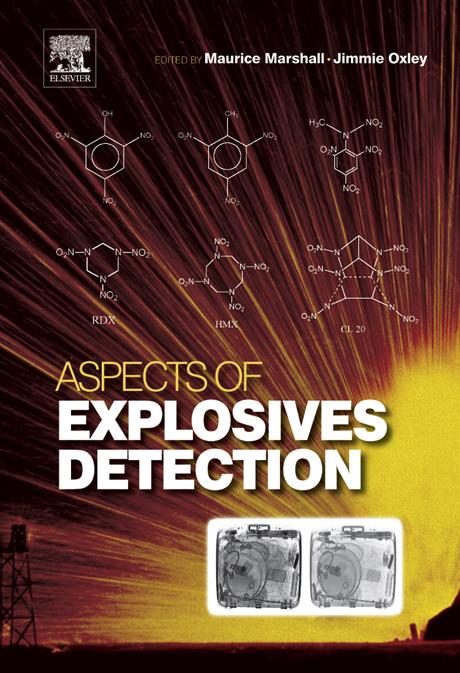
Aspects of explosives detection
Marshall, Maurice, edt, Oxley, Jimmie C, edt, ScienceDirect (Online service) · London : Academic, 2008
- Publisher
- London : Academic, 2008
- ISBN
- 0123745330;9780123745330
- Dewey classification
- 662.2
- Subjects
- Explosives--Detection--AutomationExplosives--Detection--Technological innovationsExplosives--DetectionElectronic books
- Language
- English
Summary
Detection and quantification of trace chemicals is a major thrust of analytical chemistry. In recent years much effort has been spent developing detection systems for priority pollutants. Less mature are the detections of substances of interest to law enforcement and security personnel:in particular explosives. This volume will discuss the detection of these, not only setting out the theoretical fundamentals, but also emphasizing the remarkable developments in the last decade. Terrorist events-airplanes blown out of the sky (PanAm 103 over Lockerbie) and attacks on U.S. and European cities (Trade Center in New York and the Murrah Federal Building in Oklahoma City, railways in London and Madrid)--emphasize the danger of concealed explosives. However, since most explosives release little vapor, it was not possible to detect them by technology used on most organic substances. After PanAm 103 was downed over Scotland, the U.S. Congress requested automatic explosive detection equipment be placed in airports. This volume outlines the history of explosive detection research, the developments along the way, present day technologies, and what we think the future holds. - Written by experts in the field who set out both the scientific issues and the practical context with authority - Discusses and describes the threat - Describes the theoretical background and practical applications of both trace and bulk explosives detection
Digital copy
Catalogue record
| Field | Value |
|---|---|
| 001Control number | 15939 |
| 003Control number identifier | OCoLC |
| 005Date and time of latest transaction | 7 Nov 2011, 16:18 |
| 006Fixed-length data elements – additional material characteristics | m d |
| 007Physical description fixed field | cr cn| |
| 008Fixed-length data elements | 080908s2008 enka s 000 0 eng d |
| 020International Standard Book Number (ISBN) |
|
| 035System control number | (OCoLC)246733686 |
| 040Cataloging source | OPELS eng OPELS BWX OPELS |
| 041Language code | eng |
| 082Dewey Decimal call number | 662.2 |
| 245Title statement | Aspects of explosives detection [electronic resource] / edited by Maurice Marshall, Jimmie C. Oxley. |
| 260Publication, distribution, etc. (imprint) | London : Academic, 2008 |
| 300Physical description | p. cm. |
| 505Formatted contents note | 1.The Detection Problem -- M. Marshall and J.C. Oxley -- 2.Explosives - The Threat Materials -- M. Marshall and J.C. Oxley -- 3.Detection of Explosives by Dogs -- J.C. Oxley and L.P. Waggoner -- 4.Colorimetric Detection of Explosives -- J. Almog and S. Zitrin -- 5.Nuclear Technologies -- P. J. Griffin -- 6.X-ray Technologies -- R. F. Eilbert -- 7.CT Technologies -- Richard C. Smith and James M. Connelly -- 8.Analysis and Detection of Explosives b Mass Spectrometry -- Jehuda Yinon -- 9.Advances in Ion Mobility Spectrometry of Explosives -- G.A. Eiceman and H. Schmidt -- 10.Detection of Explosives Using Amplified Fluorescent Polymers -- Samuel W. Thomas III and Timothy M. Swager -- 11.Post-Blast Detection Issues -- M. Marshall -- 12.Constitutional Aspects of Search and Seizure: -- Gil Sapir and Mark Giangrande. |
| 520Summary, etc. | Detection and quantification of trace chemicals is a major thrust of analytical chemistry. In recent years much effort has been spent developing detection systems for priority pollutants. Less mature are the detections of substances of interest to law enforcement and security personnel:in particular explosives. This volume will discuss the detection of these, not only setting out the theoretical fundamentals, but also emphasizing the remarkable developments in the last decade. Terrorist events-airplanes blown out of the sky (PanAm 103 over Lockerbie) and attacks on U.S. and European cities (Trade Center in New York and the Murrah Federal Building in Oklahoma City, railways in London and Madrid)--emphasize the danger of concealed explosives. However, since most explosives release little vapor, it was not possible to detect them by technology used on most organic substances. After PanAm 103 was downed over Scotland, the U.S. Congress requested automatic explosive detection equipment be placed in airports. This volume outlines the history of explosive detection research, the developments along the way, present day technologies, and what we think the future holds. - Written by experts in the field who set out both the scientific issues and the practical context with authority - Discusses and describes the threat - Describes the theoretical background and practical applications of both trace and bulk explosives detection. |
| 533Reproduction note | Electronic reproduction. Amsterdam : Elsevier Science & Technology, 2008. Mode of access: World Wide Web. System requirements: Web browser. Title from title screen (viewed on Sep. 8, 2008). Online version restricted to NUS staff and students only through NUSNET. |
| 650Subject added entry – topical term |
|
| 655Index term – genre/form | Electronic books. local. |
| 700Added entry – personal name |
|
| 710Added entry – corporate name | ScienceDirect (Online service) |
| 776Additional physical form entry | Original 9780123745330 0123745330 (OCoLC)241017628. |
| 999Collection | Downloads |
=001 15939=003 OCoLC=005 20111107161846.1=006 m d=007 cr cn|=008 080908s2008 enka s 000 0 eng d=020 ##$a0123745330=020 ##$a9780123745330=035 ##$a(OCoLC)246733686=040 ##$aOPELS $beng $cOPELS $dBWX $dOPELS=041 0#$aeng=049 ##$aMAIN=082 ##$a662.2=245 00$aAspects of explosives detection $h[electronic resource] / $cedited by Maurice Marshall, Jimmie C. Oxley.=260 ##$aLondon : $bAcademic, $c2008=300 ##$ap. cm.=505 0#$a1.The Detection Problem -- M. Marshall and J.C. Oxley -- 2.Explosives - The Threat Materials -- M. Marshall and J.C. Oxley -- 3.Detection of Explosives by Dogs -- J.C. Oxley and L.P. Waggoner -- 4.Colorimetric Detection of Explosives -- J. Almog and S. Zitrin -- 5.Nuclear Technologies -- P. J. Griffin -- 6.X-ray Technologies -- R. F. Eilbert -- 7.CT Technologies -- Richard C. Smith and James M. Connelly -- 8.Analysis and Detection of Explosives b Mass Spectrometry -- Jehuda Yinon -- 9.Advances in Ion Mobility Spectrometry of Explosives -- G.A. Eiceman and H. Schmidt -- 10.Detection of Explosives Using Amplified Fluorescent Polymers -- Samuel W. Thomas III and Timothy M. Swager -- 11.Post-Blast Detection Issues -- M. Marshall -- 12.Constitutional Aspects of Search and Seizure: -- Gil Sapir and Mark Giangrande.=520 ##$aDetection and quantification of trace chemicals is a major thrust of analytical chemistry. In recent years much effort has been spent developing detection systems for priority pollutants. Less mature are the detections of substances of interest to law enforcement and security personnel:in particular explosives. This volume will discuss the detection of these, not only setting out the theoretical fundamentals, but also emphasizing the remarkable developments in the last decade. Terrorist events-airplanes blown out of the sky (PanAm 103 over Lockerbie) and attacks on U.S. and European cities (Trade Center in New York and the Murrah Federal Building in Oklahoma City, railways in London and Madrid)--emphasize the danger of concealed explosives. However, since most explosives release little vapor, it was not possible to detect them by technology used on most organic substances. After PanAm 103 was downed over Scotland, the U.S. Congress requested automatic explosive detection equipment be placed in airports. This volume outlines the history of explosive detection research, the developments along the way, present day technologies, and what we think the future holds. - Written by experts in the field who set out both the scientific issues and the practical context with authority - Discusses and describes the threat - Describes the theoretical background and practical applications of both trace and bulk explosives detection.=533 ##$aElectronic reproduction. $bAmsterdam : $cElsevier Science & Technology, $d2008. $nMode of access: World Wide Web. $nSystem requirements: Web browser. $nTitle from title screen (viewed on Sep. 8, 2008). $nOnline version restricted to NUS staff and students only through NUSNET.=595 ##$fmc $zmarc.=650 #0$aExplosives $xDetection $xAutomation.=650 #0$aExplosives $xDetection $xTechnological innovations.=650 #0$aExplosives $xDetection.=655 \7$aElectronic books. $2local.=700 1#$aMarshall, Maurice. $4edt.=700 1#$aOxley, Jimmie C. $4edt.=710 2#$aScienceDirect (Online service)=776 1#$cOriginal $z9780123745330 $z0123745330 $w(OCoLC)241017628.=LDR 03795cam a2200409Ia 4500